
🗓 17 May 2022 / Design Studio
With this in mind, I visualized the socio-technical system of my project. First, I conducted some research on the topic, I learned “A socio-technical system (STS) is one that considers requirements spanning hardware, software, personal, and community aspects. It applies an understanding of the social structures, roles and rights (the social sciences) to inform the design of systems that involve communities of people and technology.” (Interaction Design Foundation). I also found some examples and visualizations online and used one as a reference for building my personal system.
I mapped out the people, culture, goals, technology, infrastructure, and processes which would be involved in my project. The project I chose to focus on is a platform for sharing and understanding diverse heritage and craft and exploring its applications for today and our future. Because I am still working out the details of this concept, creating this map was a good exercise to understand the different components and agents that could inform the direction. But I wasn’t able to complete this system as well as I hoped for.
In terms of scalability, I’m very open to the idea of distributing ownership of the project as a whole, as long as the values continue to align. Continuing as a mission-based effort, regardless of the growth, can help in making decisions for scaling and other changes that any organization will have to face. My goal is to create a framework and system in which these value-based activities can happen and evolve. Some of the open distribution methods I envision are through workshops, kits, interviews, podcasts, and other ways to distribute the knowledge and practices to individuals and communities.
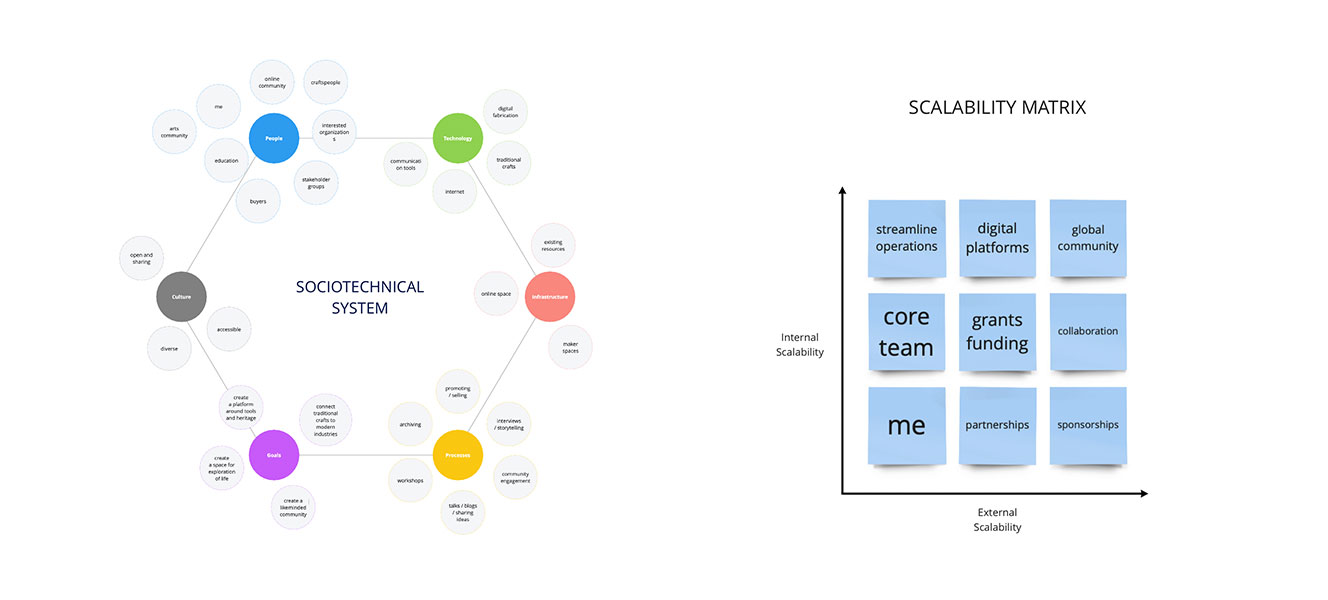
See the diagrams here.
Designing Yourself Out
In thinking about the growth and expansion of my projects, I can envision a few different approaches to growth and how I can be designed out of the equation. As I understand, designing myself out is not to restrict my involvement in the project, but rather a strategy to sustain the activities and impacts of the project in a more decentralized manner an to enable an extension of capacity of the efforts.With this in mind, I visualized the socio-technical system of my project. First, I conducted some research on the topic, I learned “A socio-technical system (STS) is one that considers requirements spanning hardware, software, personal, and community aspects. It applies an understanding of the social structures, roles and rights (the social sciences) to inform the design of systems that involve communities of people and technology.” (Interaction Design Foundation). I also found some examples and visualizations online and used one as a reference for building my personal system.
I mapped out the people, culture, goals, technology, infrastructure, and processes which would be involved in my project. The project I chose to focus on is a platform for sharing and understanding diverse heritage and craft and exploring its applications for today and our future. Because I am still working out the details of this concept, creating this map was a good exercise to understand the different components and agents that could inform the direction. But I wasn’t able to complete this system as well as I hoped for.
In terms of scalability, I’m very open to the idea of distributing ownership of the project as a whole, as long as the values continue to align. Continuing as a mission-based effort, regardless of the growth, can help in making decisions for scaling and other changes that any organization will have to face. My goal is to create a framework and system in which these value-based activities can happen and evolve. Some of the open distribution methods I envision are through workshops, kits, interviews, podcasts, and other ways to distribute the knowledge and practices to individuals and communities.
See the diagrams here.